
-Privacy Policy-
|
Article by: Robert Gross All Rights Reserved The Big Bang Creates the Universe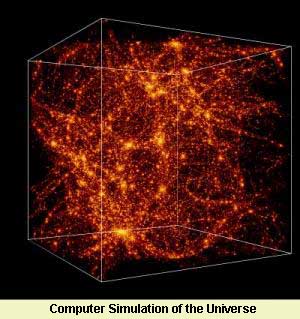
Computer Generated
Update Notice posted February, 2,2012 Posted on Wednesday 01/09/2008 Creating the Universe This is a simplistic view of what might have realistically happened if we were to allow logic without the embellishments and absurdities of some of the more popular explanations. The Big Bang may or may not be a scientific fact. The idea itself has enough logical problems to render it to the category of ‘might could have happened if’ with a big emphasis on “if”. But if we do accept the theory, then we also have to accept the idea of a ‘big crunch’. Without the big crunch, logic will not allow us to arrive at a setting for the big bang. Something from nothing just doesn’t compute. Thoughts on Energy: As a logical pursuit, there had to be a large enough energy release to cause expansion to take place. The source of the energy release to cause the great expansion has never been explained in any reading material (that I have found) or internet searches I have made. The first law of thermodynamics states that energy cannot be created or destroyed. If this is true, then the energy source that caused the expansion had to be able assert itself from within the makeup of the singularity. In other words, whatever the makeup of the singularity, it contained the bottled up energy to start the process of expansion. If the totality of the Universe was compacted to a single point, then gravity (at least momentarily) would have to have been at its possible maximum. Gravity, which caused the collapse of all matter would have been an all powerful force. So I ask, the question, "How could the maximum statement for gravity possibly have become unstable?" Being a logical creature, I can make a logical case for several ideas. One such idea is that matter and energy are the same. Atomic particles are only reservoirs of higher energetic sub-atomic particles. If that is true, then all that would be necessary to release that energy would be a force large enough to free these subatomic particles from their entropic prison. Gravitational collapse could have supplied the force necessary to free this stored energy. The smaller subatomic particles would be of such insignificant mass that the effect of gravity on them would be negligible. In addition, the breakup of the atomic particles also defeats gravity by breaking up the heavier particles so necessary to gravity. Gravity is becoming weaker as the atomic particles are being broken into their constituents. I don’t think we know yet just how small sub-atomic particles can get, and for this discussion, it isn’t important. But if the smaller sub-atomic particles represent highest energy states and the larger particles are an assembly of these small particles that have lost some of their energy, then we can account for atoms and the physical matter that we know. It would have taken the force of something like the ‘big crunch’ to break up the atomic particles into the more energetic sub-atomic particles. Mass is critical to the strength of gravity. And as in the case of the singularity, gravity becomes the fuel that ultimately is responsible for the great expansion. Entropy: Entropy is the transfer of energy from one body to another. Entropy affects everything in the Universe. Extending the process to its inevitable end, energy distribution will equalize. The energy has not been lost, just very widely distributed and irretrievable. That energy becomes locked into atomic particles that form atoms. A star is an energy converter churning out its fusion products which are in effect the lower states of energy. As energy gets locked away into larger atoms the star will eventually die. But be aware that stars are only a process of entropy running its course. Qualifications: I have no concept of the passage of time for the events in this essay, because I have no idea of how long these processes take to fulfill their destiny. But I do have faith in the process. I have no exotic math formula to prove my musings about the Universe, just faith in the logic. Beginnings: First, we need to look at the end of the previous Universe. The last Universe was here long enough to create the physical mass to overcome the remaining energy with the force of gravity. The energy of the old Universe was probably equalized throughout the Universe. Meaning that enough of the subatomic particles were grouped together forming atomic particles and atoms. Gravity depends upon mass. Atoms and molecules are massive in comparison to their higher energy subatomic particles trapped within the atomic particles that make up an atom. Gravity took control in the old Universe and started to assert itself. The old universe collapsed because energy had retreated into its lower form. The matter in the Universe reacted to the gravity that was increasing due to the mass becoming denser. As gravity acted upon the mass, the speed of the collapse also increased. Temperature was also increasing as the matter of the universe became denser. As gravity increased, atoms were being crushed into atomic particles. The change from atoms into particles was the result of compacting matter. Atoms, broken up by the great weight of all the matter of the old Universe compacted into a very dense mass. As the collapse continued, atomic particles started breaking apart into their high energy sub-atomic components, greatly increasing the released energy and decreasing the mass of the singularity. The singularity could not have been but a blush in time. The energy of the freed energetic particles from their entropic graves would have started expressing themselves immediately. The Great Expansion: Mass was decreasing as the atomic particles were being broken down into their subatomic components of higher energy. With a dwindling mass, gravity started retreating. The higher energy particles needed room and were not influenced by gravity. The expansion started. Future of Our Universe: I have no idea of a time line when the energy will give out and start the reverse process for the current Universe, but sometime in the future it will happen. (Provided there was a ‘Big Bang’) But the collapse will not happen until enough of the high energetic particles are bound and form atomic particles and atoms. It is at that point in time that the decrease in energy will have transformed enough of the subatomic particles into the mass that will give gravity the upper hand. Galaxy Beginnings: During the expansion, most of what was racing outward was energy. However, compacted atomic particles were still in existence. After all, the energizing process did not transform all of the matter. The expansion carried with it, fragmenting pieces of compacted matter. It is with one of these bits of compacted matter that we will start our Galaxy. The very strong gravity of the great crunch had compacted the matter into very dense material. But this material was only able to remain in that compacted condition as long as the super gravity was present. At the time of the great expansion, pieces flew out in all directions. When released from the shackles of the enormous gravity captor that had crushed the matter, the pieces wanted to expand. Although the pieces themselves had tremendous gravity, particles were still streaming off of these pieces of compressed matter. Clumps: These dense clumps of matter were not the elements that we are familiar with. They are clumps of very densely packed atomic particles crushed from atoms by the big crunch. Not to dwell on these clumps, but what you need to take away about them is that they are unstable without the enormous gravity that formed them. The larger pieces broke into smaller pieces until their mass was small enough and would no longer support breaking apart. Unstable: The clump pieces, though still unstable, no longer support breaking apart. Just as our Sun is constantly discharging particles in spite of its gravitational field, the same process was happening with those clumps of compressed matter, only on a much larger scale. They are expelling atomic particles. There is enormous gravity surrounding this mass but not enough to keep the mass stable. The clump diameters will differ but all are significant in size. They will spawn the seeds that will form Galaxies. Hydrogen: The elemental particles spewed out by the clump bind together. Most of particles discharged are primary particles that form hydrogen gas atoms. (An electron and a proton have a natural affinity for each other.) Hydrogen gas is coalescing around the clump and getting denser. Because of nascent gravity, pockets of the gas form and these pockets of dense gas attract other hydrogen molecules. Once the process begins, it is a self-propagating system. Birthing a Star: When enough of the hydrogen has amassed, temperature and pressure will begin the fusion process that will ignite the star. I will refer to these first stars as primary stars. The main central clump is still discharging elemental particles that continue to unite and form hydrogen atoms. These first primary stars circle the primary lump at a dizzying Newtonian pace. A Galaxy: Now we have a primordial massive clump of matter and a star formed from the gasses of the circumnuclear disk. (The Gaseous discharges orbiting around the primordial clump.) Galaxy building takes time, and essentially, we have to wait on these new solar furnaces to expend the fuel that is driving the fusion reaction of the new star. Fusion driven stars eventually expend enough of their energy for the resulting gravity to cause the star to go through its death throes. The halo of unused hydrogen and other elements fused by the star is expelled. Much of this ejected material escapes outward, away from the original central clump. Some of the ejected material is returned to the soup of matter furiously orbiting the primordial clump. I will refer to the area of matter surrounding the clump, the 'Chaotic Zone'. The Chaotic Zone: As the clump continues to discharge energy and particles into the chaotic zone, new stars form, live their life and nova out of existence. The result is a highly charged magnetic zone consisting of both hydrogen and heavier elements such as helium and calcium. This elemental soup sets the stage for the next step in Galaxy formation. Forming the Spiral Arms: When the primary stars nova, they send ejection materials outwards. The part of the explosion that travels inward is absorbed back into the soup of the chaotic zone so this essay will only deal with the outward-bound material. Magnetic forces follow the ejected mass and other material follows these spiraling magnetic forces. The ejected material continues outward. There may be several of these nova ejections around the periphery of the chaotic zone. Spiral Arms: Gravitational forces cause an alignment of the ejected material, by the stars that form in the midst of the ejected material. Those stars capture ejected material and form even more stars. Over time, the stars that live and die will eject matter. The outward-bound ejected material eventually forms more stars that gravitationally attract more of the ejected material. This material is making its way outward from the central core. Gravitational attraction is the root of creation of those spiral arms around a galaxy. The chaotic zone is producing star clusters that stay and nova, throwing a stream of material outwards from the chaotic zone. The trails of material leaving the chaotic zone get longer and over time, the galaxy will take on the appearance of what we see today. The overall diameter is a telltale of the galaxy’s age. Death of a Galaxy: When the primordial clump has expended itself and no longer can continue to feed and expand the galaxy, the galaxy will essentially die. Over time, entropy will finally claim the energy and equalize its distribution until the energy is irretrievable. One postulation is that the galaxy arms contain a lot of this energy depleted matter. The Oort cloud would be a sample of matter that although trapped by the Sun’s gravity, has no hope of igniting the fusion process. There is no telling how much of this low energy material is contained within the galaxy. The Black Hole: This author rejects the accretion theory of a super black hole that is accreting the mass of the galaxy for this reason. Whenever the 'big crunch' occurred, gravity was at its strongest. Matter compressed together under a pressure that was incalculable. There is no force in the Universe that could have so compressed matter like the force of the gravity of the whole Universe. It is impossible to achieve a greater force without borrowing matter from a neighboring Universe, if one exists. Under such compression, matter is no longer stable. These compressed chunks of matter were a part of the expansion, and in the process, the very strong gravity that had compressed the matter was no longer in existence. These very dense pieces would want to expand. Those remnants of the 'big crunch' are like the boiling mayhem of dry ice in water. They would not be accreting more matter. That is why I wrote that a fragment of the 'Big Bang' is at the center of each Galaxy. The Dispersion of Matter: The matter strewn thinly all over the Universe is the product of material thrown off of the fragmenting compressed material racing outward during the great expansion. Also, the energy causing the expansion is gradually transforming back into physical particles as the energy expends itself. The energy that governs the Universe will be expended someday and gradually, gravity will become its ruler. The Big Crunch: Physicists and Cosmologist tell us that the Universe is expanding at a greater rate than was previously thought. The acceleration part makes one wonder if we are not already collapsing. Has the 'big crunch' already started? Galaxy Rotation: I for one am not convinced that the whole galaxy is rotating around its primordial clump in any Newtonian way. Another explanation may be that what we observe are masses ejected with enough force from the chaotic zone will continue the migration outward. If you have ever observed a lawn sprinkler spinning and discharging water droplets in spirals, then the concept of ejected matter forming this same pattern is easier to grasp. I will concede that there may be enough gravitational attraction between elements of each spiral arm to effectively attract expended matter. But it is hard to think of this material circumnavigating the central core in a Newtonian fashion. Acknowledgment: My hat is off to those working to understand cosmic processes. I realize that the issues with cosmic creation are complicated. But if theories are to be accepted, they must be testable, falsifiable, and verifiable. Absent those characteristics, they are only opinion and logical guess work. This presentation combines logic along with science. I wrote this essay to present a logical format that might be possible without crutches such as dark energy, dark matter, strings, and other proposed explanations of cosmic phenomena. The Cosmos: Our Universe is infinitely interesting and I encourage any who are curious about the machinations of our Universe to study cosmology. The more you learn, the more amazed you will be.
Cheers,
Epilog: Gravitational Lens: The journals are abuzz about observed gravitational lensing. In my experiments, I have found that incoherent light does pass around objects, no matter their mass. It is light itself that wants to naturally fill in the void just past an object that it is passing by. Judge the effect for yourself. Place an object about 6 ft. in front of you and hold a pencil about 6 inches in front of one eye with the other eye closed. Now observe the object carefully. You will notice a slight bend in the light as it travels to your eyes around the narrow end of the pencil. I am no trained observer, but this effect is similar to wind rushing around an object filling the void just in front of the object. Massive Stars: The death of a massive star with its flare and collapse may actually be a 'big bang' in miniature. Its collapse, representing a small version of the big crunch, is enough to release energy created by the collapse. Space Temperature: Space has no temperature. Only matter is concerned with pressure and temperature. Pure space is just that, space. Matter responds to heat, space does not. In space, matter has to receive energy, or else it becomes really cold. The Earth owes its livable warmth to the Sun's radiation. Without that radiation from the Sun, the Earth would lose its warmth. Warmth is also a relative concept. Any entity that has a higher temperature than another is thought of as warm in comparison to the lower temperature body. All matter above absolute zero is energetic to one degree or the other. Energy (in the form of waves) that is propelling through space will strike an object. The object will gain some or all of the energy that strikes it. A wave loses its energy through interference with matter or in some cases, other waves. Energy dissipates by interacting with matter or other waves. Else, in space, the energy travels indefinitely until it interacts with something. Empty space cannot and does not interfere with the transfer of energy. Dispersion of energy from a specific point happens on its journey from the source. In the case of our solar system, the outer planets have much less energy per unit area to work with. Hence, they are colder. Note that they are not colder because space is cold.
More notes to come.
"A good listener is not only popular everywhere, but after a while he gets to
know something."
Cheers, Top of Page |

Robert's Profile
A Physics Major at the University of Texas
Robert Writes for 2 Online Magazines and three private web sites. Robert welcomes your input whether you agree or not, and will respond via published commentary to all responsible comments.
Speaking of
|